

 EN
EN 

















Movement during a fingerstick can begin outside the needle mechanism. The hand may shift, the housing may tilt, pressure against the site may vary, or the trigger action may disturb placement. These small changes can alter how a stated gauge and depth are delivered, even when the printed specification remains unchanged.
We explain positioning as a chain from grip to skin contact to needle launch. That chain separates control of the housing from control of the needle inside it, then shows how activation direction and spring behavior connect the two. Stable positioning supports consistency; it does not guarantee comfort or sample adequacy.
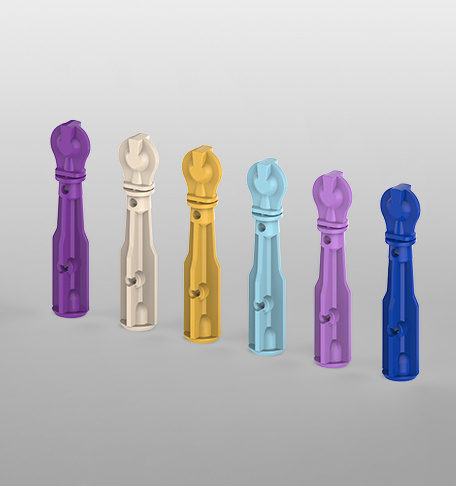
Trace Positioning Errors from the Hand to the Site
Before a blood lancet enters the skin, the device body establishes the angle and contact point. A slipping grip or incomplete contact can introduce movement before launch. The relevant evaluation begins with how the user holds, aligns, and steadies the complete device at the intended sampling site.
Trigger direction can add force to that position. Contact activation directs pressure toward the skin, a rear button adds force along the body, and a side button introduces fingertip movement across it. None is universally steadier; grip design and user technique determine how the force is managed.
Single-hand operation may reduce repositioning during preparation and activation. Its value depends on control placement, cap removal, device balance, and the user's dexterity. Observation covers the complete action because a one-handed label does not prove stable contact in every working posture.
The sampling site also matters. Skin surface, support beneath the finger, and how the hand is held can influence movement. Individual site and technique cannot be prescribed by a mechanical description, so product instructions and qualified healthcare guidance remain necessary. A positioning review can nevertheless record visible factors such as contact angle, body rotation, finger support, trigger direction, and whether the housing lifts before activation completes. Those observations make training feedback specific without turning it into personal medical advice.
Separate Housing Stability from Needle Stability
A firmly held blood lancet can still contain internal vibration, while a well-controlled launch mechanism cannot correct a moving housing. External positioning and internal needle motion are distinct layers. A design review should identify which feature addresses each layer and how both layers operate together during the puncture.
Spring architecture controls release inside self-contained products. Twin- and double-spring descriptions identify different internal systems, but spring count alone is not a quality ranking. We connect each feature to its stated function and retain gauge, depth, trigger, and grip in the same configuration record.
Reusable-device architecture adds another mechanical interface between the disposable lancet and holder. Compatibility, loading fit, selected depth, and launch stabilization all affect the puncture path. The disposable needle cannot be evaluated apart from the device that propels it.
Vibration reduction addresses unnecessary motion and leaves the nominal penetration setting unchanged. Depth still determines intended travel, and gauge still describes diameter. Stable launch makes those values more meaningful by supporting a consistent path, but it does not change what the values mean.
Compare Designs That Control Different Movements
Looking at the blood lancet systems we manufacture at SteriLance, LDE4 uses patented Soft-Stop-Control technology intended to stabilize the needle at launch and reduce vibration. It also offers nine adjustable depth settings and single-hand operation for fingertip sampling with compatible disposable lancets.
Our Soft and SoftSure options are available in 33G, 30G, 28G, and 26G, with compatibility for LDE4 and most mainstream devices. In this architecture, the holder manages depth and launch while the sterile consumable supplies the selected needle gauge.
Rear-button Elite combines its trigger with a twin-spring system intended for a smooth, accurate puncture. Elite Pro combines a rear-button layout with T-shaped grip pads and a double-spring structure. These designs address placement, trigger force, and internal movement through separate features.
Press uses contact activation and a non-slip square body, so pressure against the skin triggers puncture without a separate button movement after placement. Lite3 uses side-button activation with gentle fingertip pressure, while Lite4 uses a side-button activation design. Each arrangement creates its own positioning task.
Make Stability Part of Configuration Approval
Review of a blood lancet should document gauge, depth, grip, activation direction, spring or launch structure, compatible holder where applicable, and the intended user sequence. This prevents stable positioning from becoming a vague adjective detached from the features that may support it.
The range we manufacture at SteriLance provides reusable, contact-activated, rear-button, and side-button examples. In this analysis, we use samples to observe whether the exact model stays aligned through placement and triggering, while keeping conclusions within the conditions tested and the product's stated use.
Training can reinforce the chosen architecture. Users need to understand where to apply force, how to keep contact steady, and how to recognize completion before removal. Consistency also relies on the approved depth and gauge remaining visible in procurement and storage records.
Stable positioning matters because it protects the relationship between the selected configuration and the puncture actually delivered. Grip steadies the housing, the trigger directs hand force, and the internal mechanism guides needle motion. When those layers align, repeatability has a stronger mechanical basis.
Disclaimer: This content is provided for general health education and informational purposes only. It does not constitute medical advice, diagnosis, or treatment. Individual health conditions vary, and no health education article can replace a face-to-face consultation with a qualified healthcare professional or licensed medical institution. If you have specific health concerns or feel unwell, please seek care from a licensed medical facility and do not delay treatment because of content on this platform.