

 EN
EN 

















Needle movement has more than one form: the device can shift against the skin, the needle can vibrate during launch, or the selected puncture depth can be inappropriate if the mechanism or setting is misunderstood. Design features address these forms at different levels, so they should not be grouped under one broad stability claim.
This analysis separates movement control into housing, launch, and travel. It then connects grip surfaces, activation direction, spring structures, depth limits, and reusable-device stabilization to those layers. The purpose is to identify mechanisms, not to promise a painless or perfectly accurate puncture in every situation.
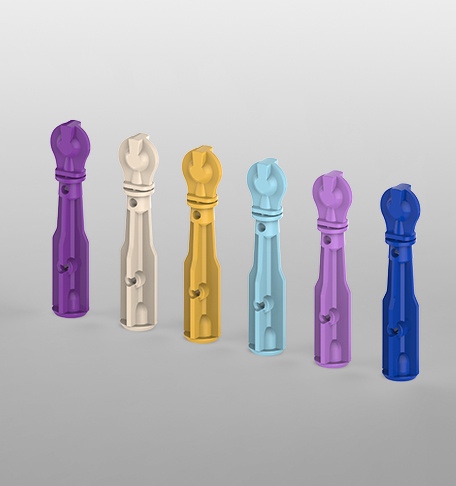
Control the Housing Before Controlling the Needle
The path of a blood lancet needle begins with the device body resting against the sampling site. Non-slip surfaces, grip pads, compact shape, and balanced one-handed handling can reduce unwanted housing movement. These features work before and during activation; needle dimensions remain unchanged.
Pressure activation can keep the main applied force directed toward the skin, while rear and side buttons introduce different hand movements. A trigger type does not guarantee stability. The housing must remain aligned as the user completes the specific motion described in the instructions.
T-shaped grip pads add contact points for the fingers, and a square non-slip body addresses rotation or slipping in another way. Within the present framework, we evaluate those geometries with representative handling instead of assuming that every hand responds identically to the same surface.
Compactness may improve portability and grip for some users, yet a smaller body can also change finger placement. The exact cap, trigger, and body should be reviewed together. Video or repeated-handling observations can show whether finger placement remains consistent from preparation through release. Stability claims are most useful when tied to the complete supplied unit.
Guide the Launch Path Inside the Mechanism
Once released, a blood lancet needle follows the path created by the holder or integrated mechanism. Stabilization structures and spring systems address this internal movement. They operate independently from the user's selected gauge, although the needle and launch system meet during the same puncture.
Vibration can add movement that is not described by gauge or depth. A Soft-Stop-Control structure is intended to stabilize launch and reduce vibration in a reusable device. This makes launch behavior another review field, not an invisible assumption behind the listed setting.
Twin-spring and double-spring systems represent alternative mechanical approaches in safety lancets. We do not infer that more springs automatically mean less movement. The stated design purpose, trigger, housing, depth control, and observed operation give the spring description its context.
Compatibility is part of launch control in reusable systems. A disposable lancet should be supported for the named holder, because fit affects how the mechanism engages it. Similar appearance cannot establish that the launch path will behave as designed. Mechanical review can compare how the consumable seats, whether the holder closes normally, how the trigger resets, and whether movement changes across repeated launches. These checks keep compatibility connected to observable operation, not visual resemblance.
Limit Travel with Defined or Selectable Depth
The intended puncture depth for a blood lancet is defined by its depth setting. Fixed products attach one value to a product code, while adjustable models provide several positions. A clear limit can reduce uncontrolled variation only when the correct configuration is identified and used according to instructions.
Across the portfolio we develop at SteriLance, Press lists 30G, 28G, and 26G at 1.8 mm. For Elite, 30G is listed at 1.5 mm and 28G or 26G at 1.8 mm. Our fixed configurations show how gauge and travel remain deliberately paired instead of being selected from unrelated fields.
Our Elite Pro provides 1.3, 1.8, and 2.3 mm settings with 28G, 26G, and 23G options. Its T-shaped grip pads and double-spring system address housing and launch while the selector addresses travel. Each feature controls a different movement layer.
LDE4 supplies nine depth positions and SSC launch stabilization. Available in 33G, 30G, 28G, and 26G, Soft and SoftSure are compatible with LDE4 and most mainstream devices. Together, the holder and compatible lancet contribute to the stability of the puncture process.
Evaluate Movement Reduction as a Layered Design
A specification for a blood lancet needle should state which feature controls the body, which guides launch, and which limits travel. Grip, trigger, spring, stabilization structure, depth, gauge, and compatibility can then be reviewed without letting one design term stand for the entire puncture.
Our SteriLance examples include Press with a non-slip square body, ImPress with compact easy-grip construction, Elite with a rear button and twin springs, Elite Pro with grip pads and double springs, and LDE4 with SSC stabilization. We preserve their differences.
Observed reduction in movement remains conditional on correct handling, the sampling site, and the tested configuration. Training and product instructions still matter, because mechanical features operate through user actions and cannot compensate for an unsuitable procedure or incompatible combination.
Needle movement is reduced most coherently when the housing stays steady, the mechanism guides launch, and penetration stops at a controlled depth. Those layers explain why several modest design choices can work together more convincingly than one oversized stability claim.
Disclaimer: This content is provided for general health education and informational purposes only. It does not constitute medical advice, diagnosis, or treatment. Individual health conditions vary, and no health education article can replace a face-to-face consultation with a qualified healthcare professional or licensed medical institution. If you have specific health concerns or feel unwell, please seek care from a licensed medical facility and do not delay treatment because of content on this platform.