

 EN
EN 

















Trigger usability emerges from the full task sequence surrounding activation. It emerges from the number of actions, the order in which they occur, the user's grip and dexterity, the need to load or adjust equipment, recognition of device state, and disposal after sampling. Different architectures move difficulty to different steps.
This comparison treats pressure, button, and reusable-device operation as task sequences. It does not equate pressure activation with automatic use or every button with manual complexity. The easier option is the one whose complete sequence fits the intended home or clinical workflow with the least avoidable ambiguity.
Count Actions Across the Whole Sampling Sequence
Pressure-activated lancing devices remove the cap, contact the site, and fire through applied pressure. Activation does not require a separate rear- or side-button press. Fewer distinct trigger actions may simplify one part of the sequence, but placement force and completion still need to follow instructions.
Button-activated safety lancets separate positioning from firing. The device is placed first, then a rear or side trigger is pressed. Some users may value that deliberate action, while others may prefer contact activation. Operator and context determine ease; the activation label alone does not.
Reusable devices add loading and equipment-management steps but may provide ongoing adjustment and a familiar personal platform. The disposable lancet is replaced while the holder remains in service. Counting only the trigger would miss most of the preparation and post-use differences among these systems.
A task map should extend through disposal. Self-contained safety units enter the sharps pathway as complete used devices, whereas a reusable lancing device remains after its lancet is removed according to instructions. We examine every handoff before judging which workflow is simpler. The comparison also records where an interrupted activation sequence would be recognized and managed. Storage location, availability of replacement lancets, and the route to the sharps container can add hidden actions that are absent from a product photograph but present in daily operation during every sampling session.
Look for Points Where Users Can Lose the Sequence
Ease among lancing devices is influenced by cap removal, grip, site contact, trigger location, setting recognition, status cues, and the number of components. A failure point may occur before activation even if the firing motion itself is simple.
Pressure activation requires firm, controlled placement until the device completes its action. Rear-button designs require the user to maintain position while pressing behind the unit; side buttons shift finger placement again. Representative handling can reveal which sequence is clearest for the intended users.
Status information may reduce uncertainty after activation. Elite includes a built-in status indicator, while Press Plus prints lot number and expiration information on the shell for unit-level identification. These features address different questions and should not be combined into one generalized ease score.
Grip geometry also changes control. A non-slip square body, compact form, or reusable pen-like holder creates a different contact with the hand. We observe whether users can maintain alignment without assuming that one body shape is comfortable or intuitive for everyone.
Compare Named Architectures Rather Than Broad Labels
Usability can be compared across our range of lancing devices at SteriLance: Press is included with one-step pressure activation, a square non-slip body, one-handed design, and listed 30G, 28G, and 26G versions at 1.8 mm. Press Plus adds a one-touch spring design and shell labeling.
ImPress also uses one-step pressure activation, offers three cap styles, and is designed to be compact and easy to grip. A rear button, twin-spring system, and status indicator characterize Elite. Lite3 and Lite4 use side-button activation with fingertip pressure..
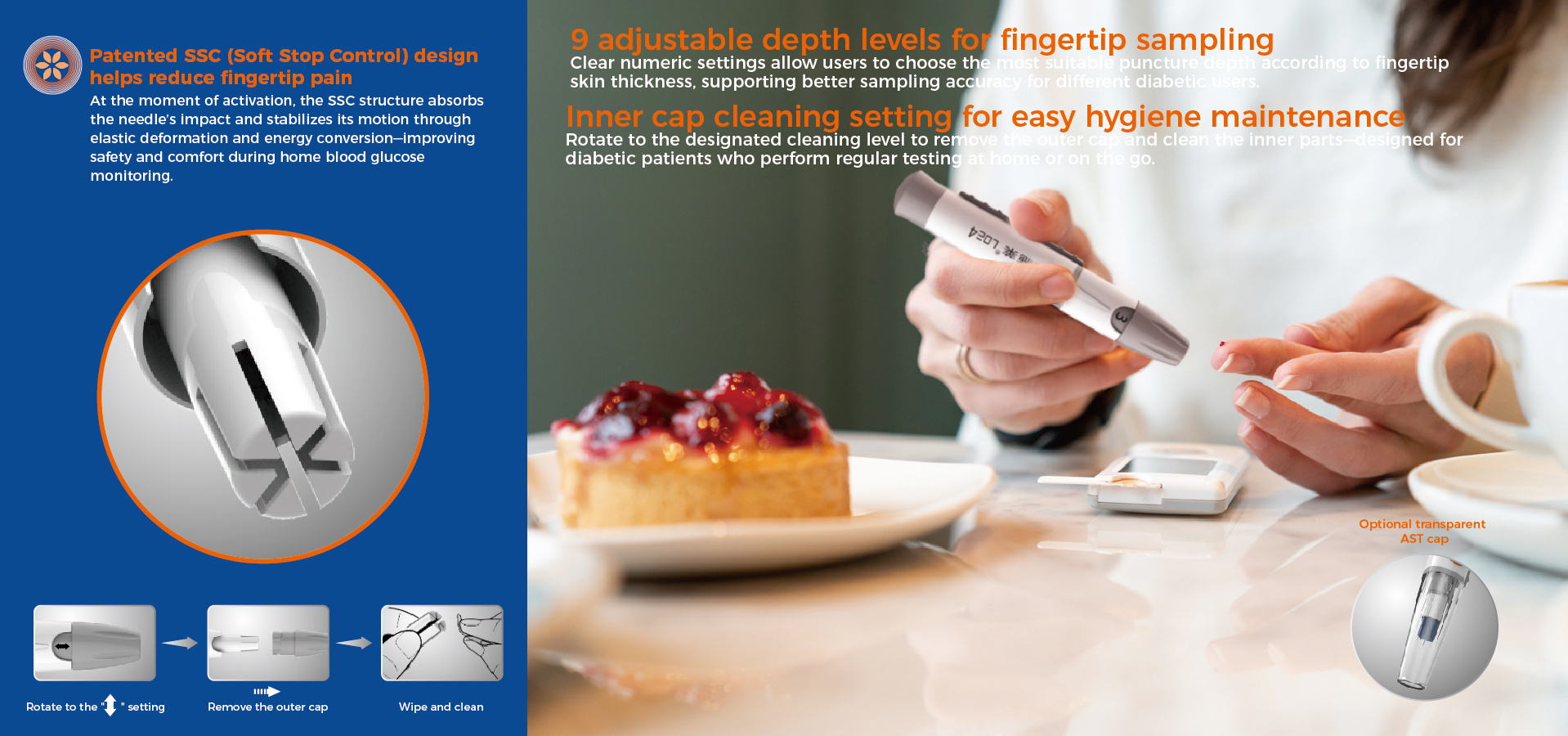
LDE4 represents our reusable approach. It accepts replaceable disposable lancets, supports single-hand operation, provides nine adjustable depth settings, and uses a Soft-Stop-Control (SSC) system to stabilize the needle at launch and reduce vibration. SoftSure fits LDE4 and is also compatible with most mainstream lancing devices, according to its product information.
These products show why automatic versus manual is an imprecise division. Contact pressure, rear-button use, side-button use, and reusable loading are concrete workflow descriptions. Buyers can compare actual tasks without implying that any architecture operates without deliberate user action.
Define Easier Through the Intended Operating Environment
Decision criteria for lancing devices can measure preparation steps, trigger clarity, grip stability, depth control, component count, training, state recognition, disposal, and repeated-use management. A home routine may emphasize repeatable self-preparation, whereas a clinical service must also control device assignment, inventory identity, staff training, and post-use flow.
Three comparison branches appear in our SteriLance portfolio. We supply pressure-activated safety lancets, rear- and side-button safety models, and LDE4 with compatible disposable lancets. Each branch retains different responsibilities before, during, and after the puncture.
Ease should be assessed with representative users and the exact supplied configuration. A familiar device may outperform a theoretically shorter sequence if staff understand it better, while a one-step pressure format may fit another program more naturally. Observations should remain tied to the tested model.
Pressure activation is easier where contact firing and fewer separate trigger actions fit the workflow. Button activation is easier where deliberate trigger control is preferred. A reusable device is easier where loading and ongoing depth adjustment are already managed. The answer belongs to the full task, not the trigger label.
Disclaimer: This content is provided for general health education and informational purposes only. It does not constitute medical advice, diagnosis, or treatment. Individual health conditions vary, and no health education article can replace a face-to-face consultation with a qualified healthcare professional or licensed medical institution. If you have specific health concerns or feel unwell, please seek care from a licensed medical facility and do not delay treatment because of content on this platform.