

 EN
EN 

















A trigger mechanism earns its place in routine sampling through fit, not novelty. Pressure activation combines placement against the skin with the device activation, while button designs separate those moments. The simpler-looking sequence may be valuable in some settings, but gauge, depth, grip, labeling, packaging, and staff practice still shape how the sequence performs.
We answer the question by testing what better must mean for a defined workflow. The comparison considers hand movement, configuration consistency, identification, training, and alternatives with rear buttons, side buttons, or adjustable depth. No activation style can be ranked responsibly without the users, specimen requirement, and operating conditions around it.
Understand What Pressure Activation Changes
With pressure-activated safety lancets, contact pressure initiates the puncture after the cap is removed and the device is positioned. The trigger does not require a separate button press. That sequence can reduce one distinct hand action, although correct placement and sufficient controlled contact remain necessary parts of use.
Button-activated models create a different rhythm. The user places the device, then presses a rear or side control. This separation may suit users who prefer an explicit trigger, while pressure activation may suit a protocol built around one-step contact. Observed hand movements provide the comparison; neither motion receives an automatic quality label.
Routine use amplifies small ergonomic differences. Body shape, non-slip surfaces, compactness, cap removal, visibility, and one-handed handling can affect how consistently staff follow the sequence. These features need representative evaluation because a description such as easy to grip may not apply identically across users or working positions.
Activation also needs to be distinguished from post-use control. Pressure activation describes how the device is activated, not the entire disposal pathway or the suitability of the gauge-depth configuration. Single-use instructions, sharps disposal, product-state recognition, and facility procedure remain separate but connected elements.
Check Whether the Specification Fits Routine Samples
The usefulness of pressure-activated safety lancets depends on the specimen requirement as much as the trigger. Needle gauge indicates diameter, while depth indicates intended penetration. A familiar activation method cannot compensate for a configuration that does not align with the approved site, patient group, or sampling procedure.
Fixed gauge-depth combinations can support a standardized routine because each product code identifies a predefined puncture specification. Their value depends on accurate stocking and correct model recognition. If the service needs controlled variation, an adjustable safety unit or a reusable lancing device with depth settings may provide a more suitable architecture.
Sample adequacy involves technique and downstream handling as well as the lancet. The discussion avoids claiming that one listed dimension guarantees a particular volume or outcome. Product instructions, relevant professional guidance, and facility protocols remain the basis for applying technical specifications to an actual sampling pathway.
A comparison should preserve exact pairings. Products within the same pressure-activated family may use different depths at different gauges, and package quantities may differ among families. We verify the product code, sample, label, quotation, box, carton, and instructions before treating two options as equivalent.
Compare Real Pressure-Activated Configurations
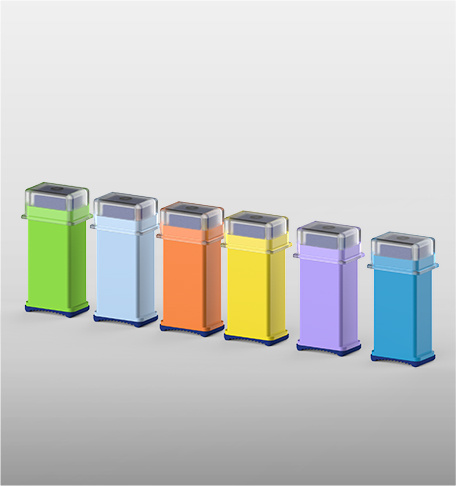
Our Press pressure-activated safety lancets use a cap-off, press, and collect workflow. The square non-slip body is designed for one-handed use. We list 30G, 28G, and 26G versions at 1.8 mm, packed 100 pieces per box and 1,000 per carton.
Press Plus uses a one-touch spring design and also supports one-handed sampling. Its shell carries the expiration date and lot number, adding visible traceability at the unit level. We list 30G, 28G, and 26G at 1.8 mm, again with 100 pieces per box and 1,000 per carton.
Our ImPress line uses one-step pressure activation and offers three cap styles within the range we document at SteriLance. It is described as compact, portable, and easy to grip. Listed specifications include 30G at 1.5 mm and 28G or 26G at 1.8 mm, with 100 pieces per box and 2,000 per carton.
These three families show why pressure activation is not one undifferentiated product. Body design, unit labeling, cap options, gauge-depth pairings, and carton quantities vary. A buyer should qualify the exact model that matches the workflow, without extending one family's feature to every pressure-activated device.
Use Better Only After Defining the Alternative
A fair assessment of pressure-activated safety lancets compares them with the mechanism that could realistically replace them. Rear-button Elite, side-button Lite3 or Lite4, and adjustable Elite Pro or Flex3 each change a different part of the process. The relevant alternative may also be a conventional lancet used with a reusable depth-adjustable holder.
Our safety portfolio at SteriLance keeps these architectures distinct so activation can be evaluated alongside gauge, depth, grip, labeling, packaging, and intended workflow. Our role is to provide documented configurations and samples; the healthcare setting retains responsibility for protocols, training, and appropriate clinical use.
Pressure activation may be the better fit where one-step contact, a predefined configuration, and the selected body design support a repeatable routine. A button trigger may fit a team that values deliberate activation, while an adjustable model may fit approved variation. None of those benefits can be inferred from mechanism alone.
The useful conclusion is conditional: pressure activation is better only when its sequence and exact specification align more closely with the sampling program than the available alternatives. Defining that condition turns a broad product claim into a testable operational decision and keeps the routine—not the trigger name—at the center.
Disclaimer: This content is provided for general health education and informational purposes only. It does not constitute medical advice, diagnosis, or treatment. Individual health conditions vary, and no health education article can replace a face-to-face consultation with a qualified healthcare professional or licensed medical institution. If you have specific health concerns or feel unwell, please seek care from a licensed medical facility and do not delay treatment because of content on this platform.