

 EN
EN 

















Depth can be fixed in the disposable device, selected on that device, or chosen on a separate reusable lancing device. Without identifying which arrangement is being discussed, a fixed-versus-adjustable comparison can mix three systems and produce an unreliable conclusion. The control's location is as important as the number printed beside it.
The comparison begins by locating that control, then considers consistency, variation, gauge, puncture site, compatibility, training, and inventory. Adjustable does not automatically mean more suitable, and fixed does not mean inflexible at the program level. Each architecture solves a different form of control within the sampling workflow.
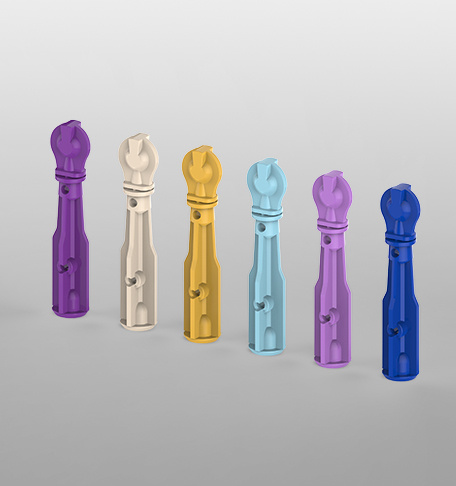
Locate the Depth Mechanism Before Comparing Values
Fixed-depth safety blood lancets carry one specified penetration depth in each disposable product code. The approved unit arrives with that characteristic already determined. A program can still stock more than one code, but the person performing the puncture does not select among depth positions on that individual device.
Adjustable safety products place several selectable depths on the single-use body. The setting is chosen before activation and discarded with the device afterward. This architecture can cover more than one approved need with one family, although clear selection and recognition become part of the user sequence.
Conventional sterile lancets create a different adjustable system. The disposable lancet may be supplied in several gauges, while a compatible reusable lancing device provides depth settings. Calling the lancet itself adjustable would obscure the lancing device's role. We describe the two components together whenever this route is evaluated.
Identical numerical depth values can belong to different workflows because the control may sit in different components. One may be permanently linked to a fixed safety unit, another selected on an adjustable safety unit, and another represented by a depth setting on a reusable lancing device. This method keeps mechanism and value paired so procurement records do not flatten unlike controls into one column.
Balance Standardization Against Managed Variation
A fixed configuration can support consistency when one puncture specification is appropriate for a defined service. With fixed-depth safety lancets in that configuration, training focuses on product identification, placement, activation, and disposal rather than on selecting a depth. Standardization still depends on correct stocking and adherence to the approved protocol.
Adjustment becomes meaningful where sampling conditions legitimately vary and the workflow defines how the setting is chosen. More positions are not an inherent advantage if users have no authorized basis for selecting among them. Selection authority, recording or recognition of the setting, and error prevention define whether those positions are usable.
Patient group, puncture site, skin characteristics, and sample requirement can influence configuration, but an informational comparison cannot prescribe an individual setting. Product instructions and qualified healthcare guidance remain decisive. Our task is to make the control structure explicit for clinical and technical reviewers applying a defined decision process.
Inventory may favor either approach. Multiple fixed codes can make each configuration visually and commercially distinct, while one adjustable family may reduce the number of model variants. That potential simplification must be weighed against setting control, packaging clarity, training, and the risk of assuming that every depth suits every use.
Add Gauge, Compatibility, and Handling to the Decision
Depth alone cannot characterize blood lancets. Needle gauge describes diameter, and the available pairings may differ by model. A comparison should retain the published gauge-depth combination, without combining the finest gauge in a family with the deepest setting unless that exact configuration is actually offered.
For reusable systems, compatibility is a second boundary. The lancet and compatible lancing device must be supported as a working combination, and the depth setting belongs to the named device. Launch stability, ease of adjustment, condition of reusable equipment, and the user's ability to identify the selected position complete the assessment.
Among the SteriLance products we use as examples here, Press and Press Plus are fixed at 1.8 mm in 30G, 28G, and 26G. The Elite model lists 30G at 1.5 mm and 28G or 26G at 1.8 mm. These product codes illustrate how fixed depth remains tied to a specific gauge rather than existing as a standalone feature.
Our Elite Pro offers 28G, 26G, or 23G with selectable 1.3, 1.8, and 2.3 mm depths; Flex3 provides the same three depth positions. On the conventional side, Soft and SoftSure list 33G, 30G, 28G, and 26G and rely on a reusable lancing device for depth control.
Let the Control Strategy Answer the Question
Choosing among blood lancets requires a statement of the desired control strategy. A fixed safety unit suits a protocol that values a predefined configuration. An adjustable safety unit suits controlled variation on the disposable device. A conventional lancet-and-holder system suits adjustment managed through compatible reusable equipment.
Across the platform we develop at SteriLance, LDE4 provides nine depth settings and uses a patented SSC structure intended to stabilize the needle at launch and reduce vibration. Compatibility with LDE4 and most mainstream devices is listed for Soft and SoftSure, allowing the reusable lancing device—not the sterile disposable lancet—to carry the adjustment function.
Technical approval should connect each choice to the intended site, gauge availability, activation sequence, user training, packaging, product codes, and ongoing supply. Samples and instructions can then confirm where adjustment occurs and how the selected state is read. That evidence is more useful than treating the largest setting range as a universal winner.
Fixed depth favors predefined consistency; adjustable depth favors managed choice. System fit depends on placing control where the program can use it accurately and repeatedly. Once that operating requirement is known, the numbers become evidence for selection instead of a substitute for the decision itself.
Disclaimer: This content is provided for general health education and informational purposes only. It does not constitute medical advice, diagnosis, or treatment. Individual health conditions vary, and no health education article can replace a face-to-face consultation with a qualified healthcare professional or licensed medical institution. If you have specific health concerns or feel unwell, please seek care from a licensed medical facility and do not delay treatment because of content on this platform.