

 EN
EN 

















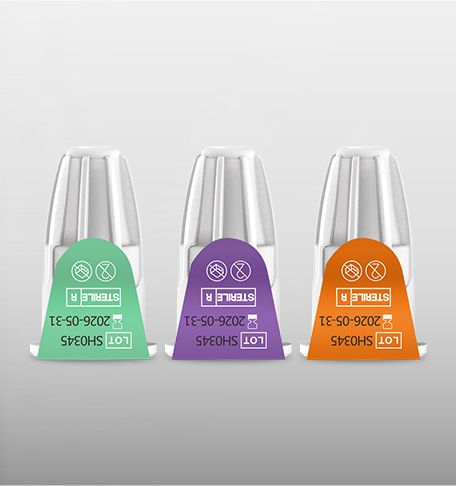
Insulin pen needles can share a familiar outline while differing at the tip, cannula wall, hub, skin-contact platform, cap, and protective mechanism. Size labels identify gauge and length, but they do not reveal every structural choice or the intended handling sequence. A complete type explanation must therefore move beyond dimensions.
We classify the products through three design aspects: the needle pathway, the pen-facing and skin-facing interface, and any safety shielding. That structure makes Plus, Safety, and Classic families comparable without implying that one type suits every person. Compatibility and individual injection technique remain subject to product instructions and healthcare guidance.
Decode Size Before Naming a Product Type
Listings for pen needles for insulin commonly pair gauge with length, such as 32G × 4 mm or 31G × 5 mm. Gauge describes diameter, with a higher gauge number indicating a thinner needle, while millimeters describe length. Neither value should be substituted for the other in comparison or ordering.
Two needles with the same length may use different gauges, and one gauge may appear in more than one length. Bevel configuration can add another variant within an identical nominal size. We preserve all three fields because a three-bevel configuration does not automatically represent a five-bevel configuration from the same family.
Cannula wall design affects the internal pathway independently of external gauge. An extra-thin-wall description therefore belongs beside, not instead of, the diameter and length. Tip geometry, lubrication, and sterilization method also describe different aspects of the needle and need product-level evidence.
Size selection is not a general instruction for personal treatment. Injection technique, the named pen system, product instructions, and qualified healthcare advice define actual use. Our educational comparison explains what the labels mean and which questions a manufacturer should be able to answer for the quoted configuration.
Examine the Hub, Platform, and Caps
The hub of pen needles for insulin transfers handling forces between the pen and cannula. A wider design may be intended to improve lateral stability and reduce bending or breakage. That design intent should be assessed through the exact product structure and supporting information, without becoming a universal performance guarantee.
A skin-contact platform introduces another interface with the body. Its geometry can be designed to support controlled penetration depth, but the platform does not erase the importance of length, technique, or compatibility. Its dimensions belong to the complete interface design and do not function as an isolated comfort claim.
Inner and outer caps affect preparation and disposal handling. Enlarged easy-grip profiles may offer more surface for the fingers, particularly where fine components are difficult to manipulate. Representative samples can show whether removal and replacement steps align with the intended users and product instructions.
Interface review also includes attachment to the named insulin pen. Visual similarity is not evidence of compatibility. We connect the hub design, product code, size, packaging, and instructions to the evaluated pen system before a commercial family is treated as suitable for a particular program.
Distinguish Standard and Safety-Oriented Families
A standard type of pen needles for insulin may emphasize cannula wall, bevel, sterilization, coating, and caps. A safety-oriented type adds a protective mechanism for a specific handling risk. Shielding does not replace the underlying needle specification, and standard construction does not mean quality controls are absent.
Safety shielding can be designed to reduce needlestick risk from either end of the needle. Review should follow the protection sequence, visibility, hub stability, and instructions while preserving cautious language about risk. Staff training and sharps procedures remain necessary around any protective feature.
Component-level differences are visible in this SteriLance product comparison: our Plus family uses Hextra Tech, including a widened hub, a skin-contact platform described as 12 times larger than that of a standard pen needle, and enlarged easy-grip caps. The listed 32G × 4 mm model is available with three-bevel and five-bevel tips.
Shielding intended to reduce needlestick risk from either end appears in our Safety family, together with the larger skin-contact platform concept. Listed sizes include 31G × 5 mm, 30G × 8 mm, and 30G × 5 mm. These models create a handling category that must still be evaluated by exact size and instructions.
Verify the Manufacturer Behind Each Configuration
Manufacturing evidence for pen needles for insulin begins with agreement among specification, sample, packaging, instructions, and quotation. Gauge, length, bevel, wall design, hub, safety features, sterilization, coating, and case count should remain tied to one product identity. A broad company claim cannot repair a mismatch among those records.
The Classic family we manufacture at SteriLance lists 32G × 4 mm, 31G × 5 mm, and 31G × 6 mm in three-bevel and five-bevel versions. Our stated construction includes an austenite extra-thin-walled design, cobalt-60 gamma sterilization, optimized bevel geometry on an ultra-sharp cannula, and medical-grade silicone coating on both needle ends.
Packaging for Plus 32G × 4 mm is listed at 100 pieces per box and 2,000 per case. Packaging should be verified for the exact family, not generalized across the portfolio. We also review traceability, change communication, market documentation, and production controls when a buyer moves from comparison to qualification.
In use, type becomes a bundle of connected design decisions: size, tip, cannula, hub, skin interface, caps, and protection. Manufacturers make those bundles traceable through consistent evidence. Reading the bundle as a whole explains the real differences among pen needles more accurately than choosing from gauge and length alone.
Disclaimer: This content is provided for general health education and informational purposes only. It does not constitute medical advice, diagnosis, or treatment. Individual health conditions vary, and no health education article can replace a face-to-face consultation with a qualified healthcare professional or licensed medical institution. If you have specific health concerns or feel unwell, please seek care from a licensed medical facility and do not delay treatment because of content on this platform.