

 EN
EN 

















Control of penetration depth can remain fixed in a disposable unit, become selectable on that unit, or sit in a lancing device. A program can standardize one fixed-depth unit, place selectable depth on each disposable safety lancet, or keep adjustment on a lancing device. Those choices distribute responsibility differently before the needle reaches the skin.
Control ownership provides the organizing question, while user categories enter only after the mechanism is clear. We then separate depth from gauge, examine repeatability and training, and connect the architecture to actual product configurations. Individual settings remain a matter for instructions and qualified healthcare guidance, not a universal rule derived from age or skin appearance.
Ask Who Controls the Setting and When
An adjustable lancing device places penetration selection on a holder itself. The setting can remain in place across repeated use or be changed under an approved process, while the sterile lancet is replaced. The user or caregiver manages the depth setting separately from the disposable lancet specification.
Adjustable safety lancets move the choice onto every single-use unit. Selection occurs before that unit is activated and the control is discarded afterward. This format may suit a setting that wants a self-contained device but still needs documented depth variation; it also requires the chosen position to be recognized each time.
Removing the setting step is a defining feature of fixed-depth safety models. Each product code carries one defined depth, often with a specified gauge. A service can stock several fixed codes for different approved pathways, though inventory identification then becomes the mechanism by which variation is controlled.
None of these architectures decides who is clinically suited to a depth. We distinguish the technical location of control from the professional decision that governs it. That separation prevents a convenient adjustment dial from being treated as permission for arbitrary changes or a fixed model as appropriate for everyone.
Keep Gauge and Penetration as Independent Variables
With an adjustable lancing device, the lancet supplies gauge while the device supplies depth settings. A finer or larger gauge number does not identify the selected penetration position, and a deeper holder setting does not change needle diameter. Both variables need their own field in product evaluation and user instructions.
Self-contained safety devices may publish gauge-depth pairings. A 30G model can carry a different fixed depth from a 28G model within one family, while an adjustable family may offer several gauges and several selectable depths. Reviewers should confirm the exact combinations, without constructing options from separate catalog columns.
Required specimen characteristics influence the configuration, but sample adequacy also depends on site, technique, timing, and downstream handling. Neither gauge nor depth is treated as a standalone promise in this evaluation. The relevant care protocol determines how technical values are applied to the intended user and test.
Repeatability has two meanings here. Mechanical repeatability concerns whether the device launches and holds the selected state consistently. Procedural repeatability concerns whether users choose and recognize the authorized configuration. A sound comparison asks how both forms of consistency are supported.
Match the Architecture to Training and Workflow
Choice among users often reflects who prepares the device, how frequently it is used, and whether equipment remains assigned. An adjustable lancing device may fit repeated personal monitoring with a compatible consumable system. A self-contained fixed or adjustable safety unit may fit a clinical protocol organized around complete single-use products.
Training changes with the control location. A reusable lancing device requires loading, depth recognition, compatible lancet management, and governance of the device between uses. An adjustable safety lancet requires a fresh setting decision on each unit. Fixed-depth stock requires reliable product-code recognition and segregation where several configurations coexist.
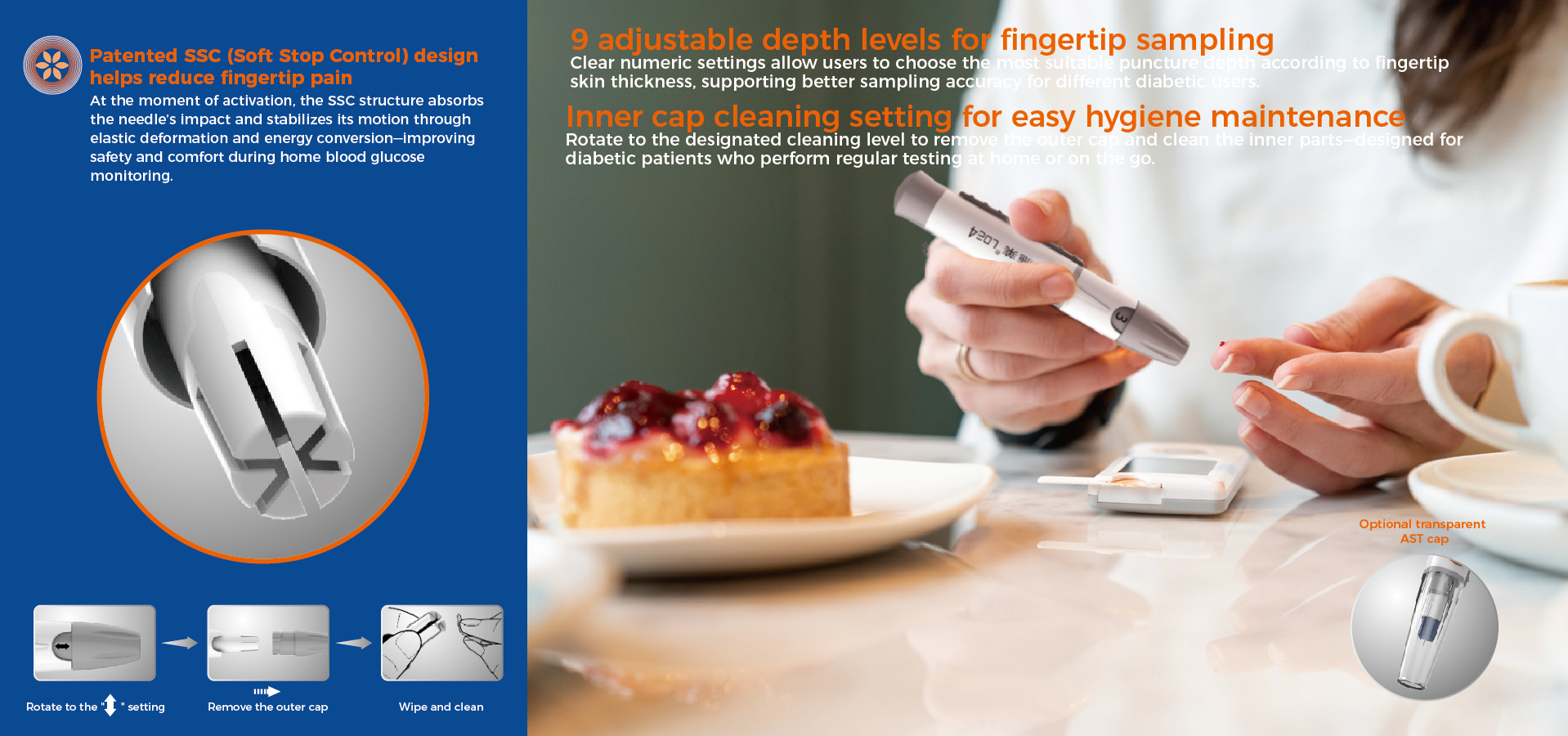
Three control locations can be illustrated within the range we develop at SteriLance: LDE4 provides nine depth settings for fingertip sampling, supports single-hand operation, and uses an SSC structure intended to stabilize launch and reduce vibration. Reusable-device compatibility for our Soft and SoftSure lancets includes LDE4 and most mainstream models; the lancets come in 33G, 30G, 28G, and 26G.
Our adjustable safety lancets place depth control on the disposable unit. Elite Pro lists 28G, 26G, and 23G with 1.3, 1.8, or 2.3 mm selections, while Flex3 also provides those three depths. The two systems show that adjustable penetration can reside in fundamentally different components.
Choose a Control Model, Not a Universal Depth
A final decision about an adjustable lancing device should state why reusable adjustment fits the users and operating environment. The same discipline applies to adjustable disposable and fixed-depth formats. Without a documented control model, the presence or absence of selectable positions becomes a feature count, not a reasoned choice.
Our fixed-depth comparison at SteriLance includes Press and Press Plus at 1.8 mm in 30G, 28G, and 26G. Elite lists 30G at 1.5 mm and 28G or 26G at 1.8 mm. These defined combinations can support pathways that do not require an on-device depth decision.
We connect the chosen architecture to user group, puncture site, specimen requirement, gauge, setting authority, training, product identification, compatibility, and disposal or reusable-device controls. A change in user population or workflow can then be reviewed against the original rationale, not handled through informal preference.
Fixed depth supports a predefined specification; disposable adjustment supports controlled choice on each unit; reusable adjustment supports repeated choice on a managed lancing device. Selecting among them means deciding where variation can be governed most reliably, while any individual setting remains outside a generic product comparison.
Disclaimer: This content is provided for general health education and informational purposes only. It does not constitute medical advice, diagnosis, or treatment. Individual health conditions vary, and no health education article can replace a face-to-face consultation with a qualified healthcare professional or licensed medical institution. If you have specific health concerns or feel unwell, please seek care from a licensed medical facility and do not delay treatment because of content on this platform.