

 EN
EN 

















Penetration depth is the intended travel distance assigned by the device configuration, not a rating of comfort. A setting that is suitable in one sampling situation may be unsuitable in another because skin characteristics, puncture site, required specimen, gauge, launch behavior, and testing frequency change the context. The number must be interpreted inside that system.
We organize depth selection as a sequence of questions, not a shallow-to-deep ranking. The sequence starts with the sampling requirement, identifies where adjustment resides, and then checks whether the chosen configuration can be recognized and repeated. Individual settings remain subject to instructions and qualified healthcare guidance.
Let the Sampling Requirement Lead the Dial
Each adjustable lancing device should first be judged against what the approved sampling pathway requires. Specimen volume, puncture site, user characteristics, and downstream testing establish the purpose of the setting. A depth number viewed before those conditions can look precise while answering the wrong question.
Greater penetration can be associated with a larger blood sample in adjustable safety lancets, yet volume is not determined by depth alone. Gauge, site preparation, technique, skin characteristics, launch motion, and specimen transfer also matter. A deeper position is not accepted as an automatic solution to every collection problem in this evaluation.
Comfort creates another boundary, not a universal rule. Too shallow or too deep cannot be defined for an individual through a general article. The useful technical task is to identify available positions and allow an appropriate selection to be made according to product instructions and professional guidance.
Frequency influences the decision because a chosen setup may be repeated many times. A setting that is difficult to recognize or drifts during handling can undermine consistency even if its nominal value appears suitable. Buyers should examine control markings, tactile movement, and the way the device retains the intended position.
Locate Adjustment in the Correct Component
The adjustable lancing device places depth control on a reusable lancing device while the disposable lancet supplies the sterile needle. The selected position remains part of the reusable platform. Gauge and depth are separate specifications, yet both must appear in the record for the complete configuration.
An adjustable safety lancet can provide several depth settings through an adjustable head on the single-use device. The depth is selected for that unit, and the disposable lancet is discarded after use. This architecture can address varied sampling requirements without a separate holder, although every use includes a fresh setting-recognition step.
A third arrangement appears in fixed-depth safety products. A defined gauge-depth pair belongs to each product code, removing adjustment from the user sequence. A facility may still stock multiple codes, so variation is governed through inventory identification instead of a dial or selector.
Confusion arises when a reusable lancing device setting is discussed as though it were printed in millimeters on the lancet. We name the controlling component, the gauge, and the model in one record. That practice prevents values from separate architectures being combined into a nonexistent product.
Evaluate Setting Stability and Needle Motion
Depth on an adjustable lancing device matters only if the chosen position can be reproduced and the launch remains controlled. Mechanical stability addresses needle movement, while the dial addresses travel selection. A larger number of settings does not automatically improve either function.
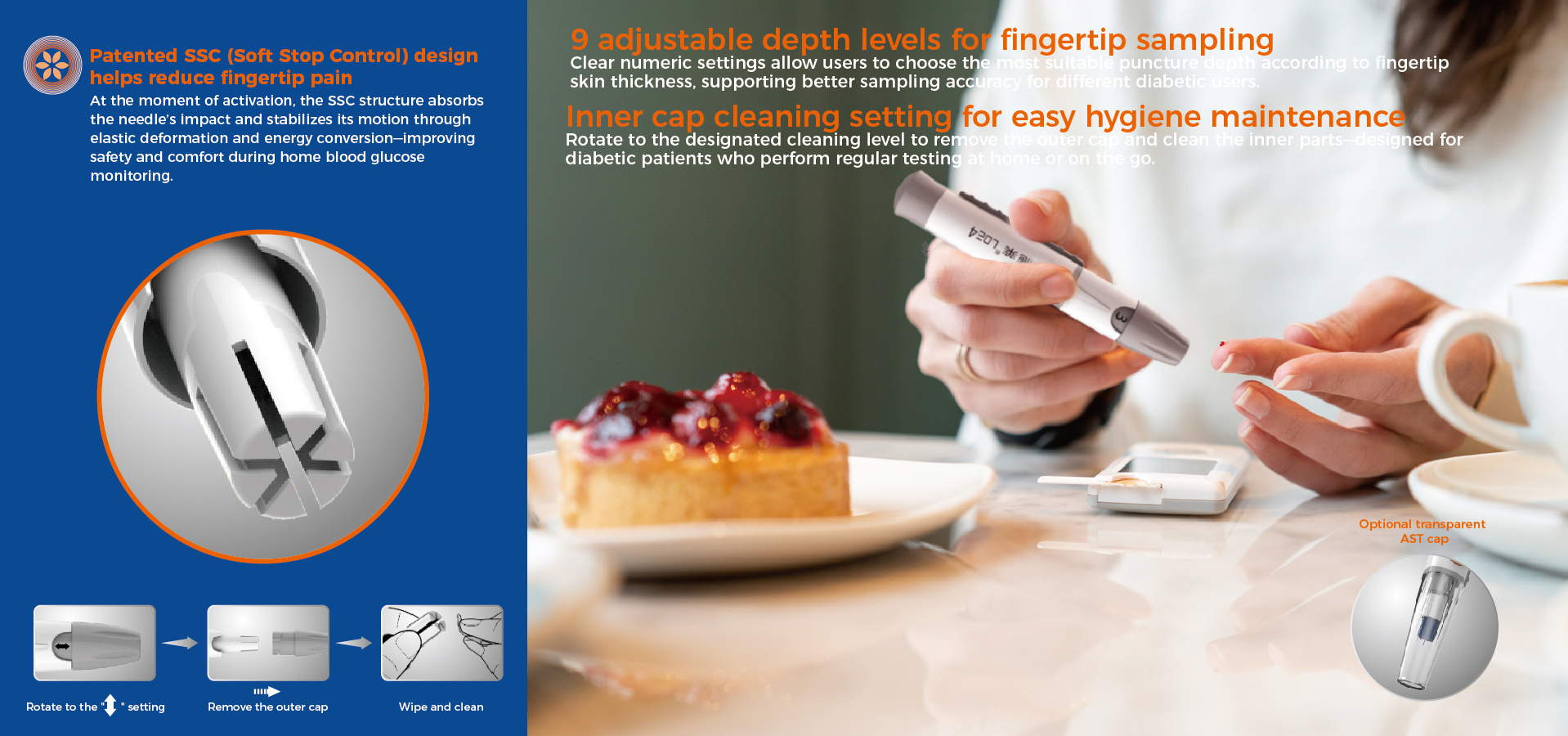
Depth control on reusable equipment is represented by our LDE4, which provides nine normal adjustments for fingertip capillary sampling across the portfolio we manufacture at SteriLance. The device supports single-hand operation and uses a patented Soft-Stop-Control structure intended to stabilize the needle at launch and reduce vibration.
Compatible consumables in our range include Soft and SoftSure for LDE4 and most mainstream reusable lancing devices, available in 33G, 30G, 28G, and 26G. Positioned for safe, low-pain fingertip sampling and frequent glucose checks, SoftSure connects reusable depth control to a stated recurring-use context.
The LDE4 product code is 02-2201, with a gray-and-white body, one piece per box, and 100 pieces per carton. Packaging for Soft and SoftSure contains 100 pieces per box and 5,000 pieces per carton. Separate pack quantities reflect the different replacement cycles of holder and consumable.
Record the Rationale So the Setting Can Be Revisited
The approved specification for an adjustable lancing device should state the sampling purpose, selected depth, lancet gauge, compatible consumable, launch features, testing frequency, assignment model, and source of the authorized setting. This turns a dial position into a controlled decision, not an informal preference.
Our SteriLance Elite Pro demonstrates adjustment on a safety lancet, not a reusable lancing device. Its listed 28G, 26G, and 23G versions can be set to 1.3, 1.8, or 2.3 mm. We keep this architecture distinct from LDE4 even though both offer selectable penetration.
Changes in skin condition, sample pathway, device model, lancet gauge, or professional instructions may justify review of the original setup. The prior rationale gives the reviewer a stable comparison point. It also prevents a familiar setting from being carried into a materially different configuration without examination.
Penetration depth is acceptable when the authorized value fits the required sample and can be reproduced within a compatible, stable system. It is not automatically the shallowest, deepest, or middle position. Selection becomes defensible when the purpose, controlling component, gauge, and operating conditions remain connected.
Disclaimer: This content is provided for general health education and informational purposes only. It does not constitute medical advice, diagnosis, or treatment. Individual health conditions vary, and no health education article can replace a face-to-face consultation with a qualified healthcare professional or licensed medical institution. If you have specific health concerns or feel unwell, please seek care from a licensed medical facility and do not delay treatment because of content on this platform.