

 EN
EN 

















An adjustable selector is useful when its positions are understandable, stable, and linked to a defined sampling need. Otherwise, added choice can create variation instead of managing it.
Our explanation treats adjustable depth as a feedback mechanism between sample need and puncture configuration. This discussion examines what changes physically, how the user recognizes that change, and where the control sits in reusable and disposable systems. The goal is controlled adaptation, not unrestricted experimentation with settings.
Depth Adjustment Changes Travel, Not Needle Diameter
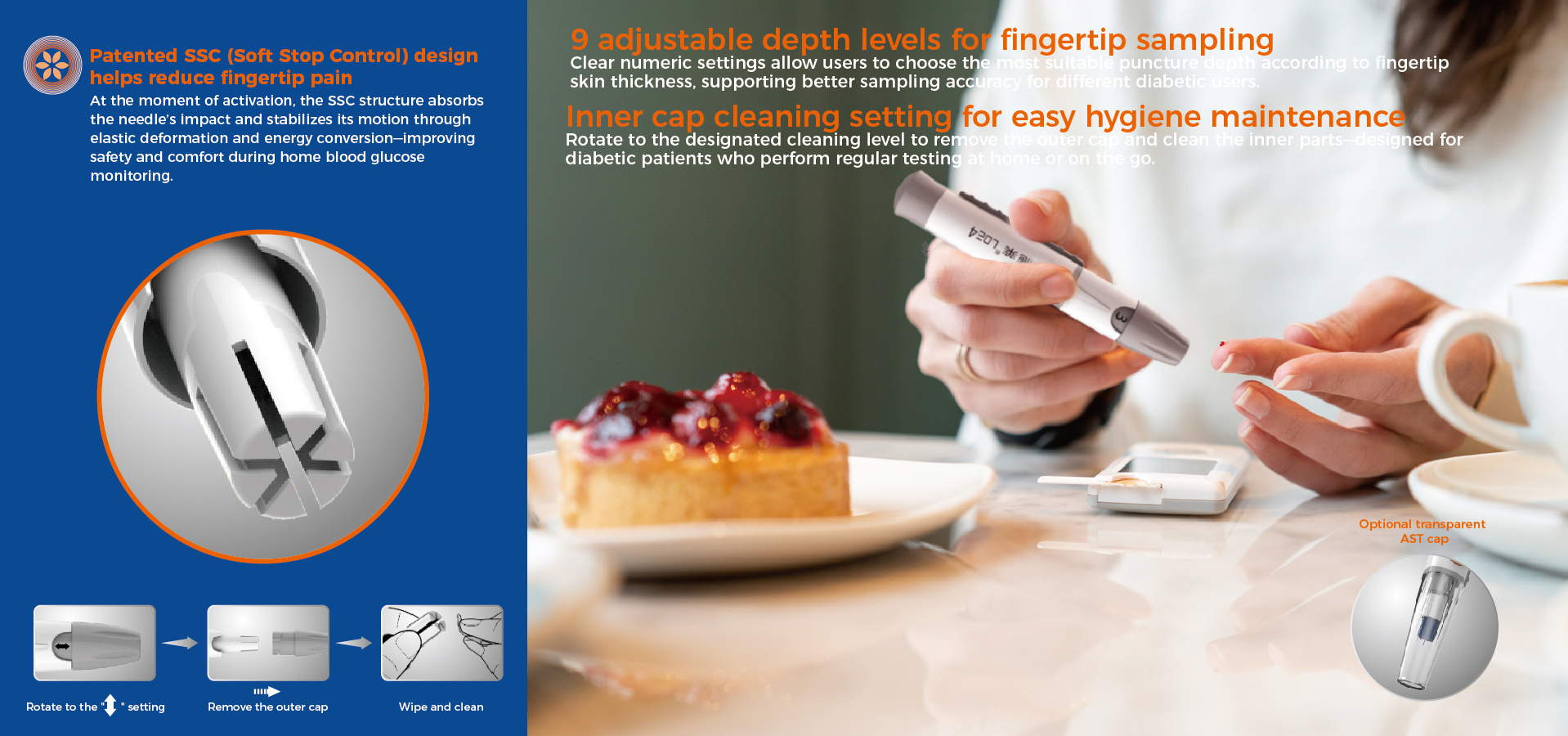
Turning an adjustable lancing device to another position changes the intended penetration setting while the loaded lancet gauge remains the same. Needle diameter is represented by gauge and selected through the compatible consumable. Keeping those dimensions separate prevents the dial from being misread as a needle-size control.
Travel distance can influence the amount of blood obtained, while specimen condition still reflects site, technique, skin characteristics, launch motion, and handling. In adjustable safety lancets, greater depth is associated with a larger blood sample; that relationship still needs to be applied within the stated procedure.
Comfort needs may also vary, particularly during repeated fingertip checks. Adjustment provides a way to respond within the device's available range, yet no setting can be recommended generically for every person. The record keeps healthcare guidance and product instructions at the point where technical capability becomes individual use.
The practical value lies in narrowing mismatch. A controlled setting can reduce reliance on one fixed setup across unlike conditions, while documentation keeps the change explainable. Adjustment manages defined variation; it is not an outcome by itself. The rationale should also remain visible when the setting is reviewed later.
A Useful Control Must Be Readable and Repeatable
Multiple positions on an adjustable lancing device matter only when users can identify the selected one. Clear markings, defined steps, tactile feedback, and stable retention contribute to repeatability. A wide range with an ambiguous selector can be less useful than fewer positions governed well.
Single-hand operation affects how the device is prepared and placed while a setting is maintained. It may support a repeated self-testing routine, though it does not remove the need to load a compatible sterile lancet, follow instructions, and manage the reusable unit appropriately.
Launch stability is another mechanical consideration. A structure intended to steady the lancet and reduce vibration addresses movement after release, whereas the selector determines depth. We evaluate both because a precise setting does not explain how smoothly the needle reaches it.
A repeatable process also requires a known consumable. Compatibility, gauge, product identification, and physical fit should remain constant when the effect of depth is being assessed. If the lancet family changes at the same time, the user may attribute multiple differences to the setting alone. Recorded product codes and lot identity give later observations a stable reference for comparison across repeated sessions.
Compare Reusable and Single-Use Adjustment
Within a reusable adjustable lancing device, depth positions remain on one holder across multiple lancet changes. Our SteriLance portfolio places nine settings on LDE4 and a Soft-Stop-Control mechanism intended to stabilize launch and reduce vibration during fingertip puncture. The holder is designed for single-hand operation.
The Soft and SoftSure disposable lancets in our range are compatible with LDE4 and most mainstream devices. Both are offered in 33G, 30G, 28G, and 26G, with 100 lancets per box and 5,000 per carton. SoftSure is designed for frequent checks and low-pain fingertip sampling.
Elite Pro provides a contrasting form of adjustment on a self-contained safety lancet. Listed 28G, 26G, and 23G configurations offer 1.3, 1.8, and 2.3 mm settings. A rear-button design, T-shaped grip pads, and a double-spring structure define other parts of its handling and launch system.
The two architectures allocate control differently. LDE4 retains the selector on reusable equipment, while Elite Pro places it on every disposable unit. Holder management belongs in procurement and training for one architecture; repeated setting confirmation belongs in the other.
Use Adjustment Only Where Variation Has a Purpose
The role of an adjustable lancing device is justified when a program can explain why different depths may be needed and how the correct position is chosen. Skin thickness, sample-volume requirement, testing frequency, compatible gauge, and puncture stability provide relevant fields for that explanation.
Our LDE4 at SteriLance is intended for fingertip sampling and provides a broad nine-position control. Elite Pro offers three millimeter-labeled safety-lancet depths. The two architectures document different ways to manage variation; neither implies that every available position must be used.
Training can define who may change a setting, how the position is verified, and what prompts review. A personal home-use routine and a clinical protocol may govern the same technical feature differently. Operating conditions, not the number of settings alone, determine which model fits the program.
Adjustable depth matters because it can align penetration more closely with a defined sampling condition while retaining a known device architecture. Its benefit depends on disciplined selection and repeatability. Each change needs a reason, a recognizable setting, and a procedural boundary before adjustability becomes useful.
Disclaimer: This content is provided for general health education and informational purposes only. It does not constitute medical advice, diagnosis, or treatment. Individual health conditions vary, and no health education article can replace a face-to-face consultation with a qualified healthcare professional or licensed medical institution. If you have specific health concerns or feel unwell, please seek care from a licensed medical facility and do not delay treatment because of content on this platform.