

 EN
EN 

















Cross-contamination requires a route by which biological material moves from one person, surface, or device state to another. In capillary sampling, that route can involve a reused sharp, a compromised unused unit, contact with an exposed needle, or a spent device that remains outside controlled waste handling.
We analyze prevention as a set of barriers placed along that route. Intact protection establishes the unused state, one-time activation separates users and procedures, retraction contains the sharp, irreversible locking resists later exposure, and immediate disposal removes the spent unit from circulation. No barrier replaces correct storage and staff practice. Contamination control and sample adequacy also require separate review: a device may complete its one-way safety sequence correctly even though the specimen itself still requires evaluation under the test procedure.
Identify Where Material Could Cross Between Procedures
A new set of single-use safety lancets should enter the workflow with protective caps intact and within the stated use-by period. A cap that has already been removed changes the known condition of the unit, so the instructions direct users not to proceed with it.
Reuse creates the clearest route between separate sampling events. A product intended for one activation and one puncture should not return to the supply area or be applied to another person. Device architecture and procedural controls must support the same one-way movement. Receiving, storage, and point-of-use checks can confirm that unused stock has not crossed into the waste stream, while immediate segregation prevents spent housings from moving back toward clean supplies.
Exposure after puncture can also create contact with contaminated sharps. If the needle remains accessible, hands, nearby materials, or surfaces may enter the pathway. Retraction narrows that opportunity by withdrawing the sharp into the housing immediately after tissue penetration.
Waste placement completes the separation. A used unit left on a tray or moved through an uncontrolled space remains part of the care environment. A suitable sharps container provides the intended destination; its location and availability belong to operational control, not product design.
Build a One-Way Device-State Sequence
A useful state sequence for single-use safety lancets is directional: protected and unused, prepared, activated once, locked after puncture, then discarded. Each state should be recognizable enough that an operator does not confuse a spent unit with stock or attempt another activation.
Automatic return of the needle and irreversible locking perform different tasks. Retraction changes the sharp's position; locking maintains the contained state. Together they reduce the need to recap, bend, disassemble, or otherwise manipulate a contaminated needle before disposal.
Trigger design governs how the device reaches the post-activation state. Trigger formats including contact pressure, rear buttons, side buttons, and adjustable-depth mechanisms require different hand actions. Their relevance to infection control lies in supporting predictable activation while maintaining a one-device, one-site, one-disposal workflow.
Exact-model training reinforces the transitions between protected, active, locked, and discarded states. Staff need to know what an intact cap looks like, how activation is confirmed, which part remains safe to hold, and where the unit goes immediately afterward. Generic familiarity is not enough.
Connect Design Evidence with Manufacturing Controls
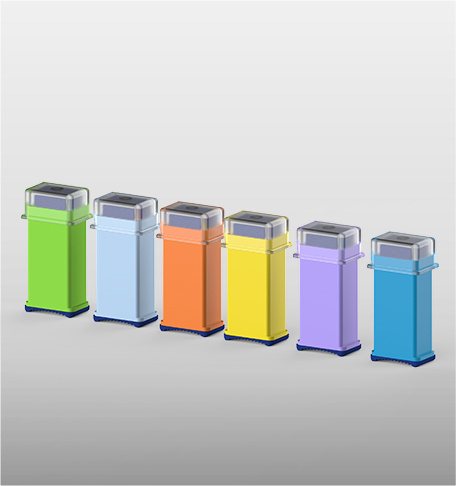
Within the single-use safety lancets portfolio we document at SteriLance, Press and Press Plus use contact activation, and ImPress uses one-step pressure activation. A rear-button format with a status indicator is used by Elite, while Elite Pro offers selectable depths of 1.3, 1.8, and 2.3 mm.
The sharp remains concealed before use and retracts into the plastic housing after puncture. An irreversible lock is intended to prevent renewed exposure and reuse. These features address the device state; staff procedures still govern storage, preparation, and waste transfer.
Our stated quality controls include inline inspection and TPM systems, EN ISO 13485:2016 certification, MDSAP certification, the UL 21 CFR Part 820 quality-system credential, and China Medical Device GMP certification.
Listed regulatory milestones include NMPA registration, FDA 510(k) completion for the United States, and CE marking under the EU MDR. For this analysis, we treat these records as evidence of defined controls and market status, not as evidence of a specific cross-contamination outcome.
Audit Every Barrier as Part of One System
An evaluation of single-use safety lancets can trace unit receipt, cap condition, date check, opening, activation, sharp withdrawal, locked status, separation from unused stock, and placement in the container. A gap at any handoff should be documented and reviewed under the applicable quality or infection-control procedure. We can distinguish a product issue from a workstation issue by documenting where the barrier failed, which model and lot were involved, what the operator observed, and whether the event occurred before or after activation.
Our SteriLance instructions define the products as single-use capillary blood-collection devices, prohibit reuse, and direct disposal into a suitable sharps container. Our educational material keeps these instructions central, without presenting containment as permission for delayed waste handling.
Observation in the intended setting can reveal whether containers are within reach, whether used-state cues are understood, whether similar units are mixed, and whether interruptions cause spent devices to be placed temporarily on work surfaces. Those findings connect product selection with local infection-control practice.
Cross-contamination risk is reduced most coherently when each procedure begins with a protected new unit and ends with an inaccessible sharp outside the usable inventory. The intended outcome is to reduce opportunities for a used unit to return to patient contact through appropriate containment, handling, and disposal.
Disclaimer: This content is provided for general health education and informational purposes only. It does not constitute medical advice, diagnosis, or treatment. Individual health conditions vary, and no health education article can replace a face-to-face consultation with a qualified healthcare professional or licensed medical institution. If you have specific health concerns or feel unwell, please seek care from a licensed medical facility and do not delay treatment because of content on this platform.