

 EN
EN 

















A reusable lancing device and its sterile lancets operate on different replacement clocks during daily sampling. The durable device may remain in service while a sterile lancet is replaced at every puncture, creating two distinct product cycles that must stay synchronized.
Repeated use is examined across continuity of settings, supply, and handling; one demonstration cannot show that span. Depth recognition, one-handed handling, launch stability, lancet fit, gauge supply, replacement discipline, portability, and replenishment all affect whether the routine remains understandable over time. Individual technique and health decisions require appropriate professional guidance. Continuity during travel, schedule changes, or replenishment delays also enters the continuity assessment, since repeated daily use extends beyond an ideal demonstration setting.
Understand the Holder-and-Consumable System
Reusable lancing devices contain the mechanism that launches the needle and may provide depth adjustment. The compatible disposable lancet supplies a fresh needle for each puncture. Evaluating only the holder overlooks the consumable that repeatedly enters the system. The interface between them deserves a named check: loading fit, closure, release, and removal should follow the documented sequence without improvised force. The user's supply record retains the exact compatible product reference.
Compatibility is a mechanical requirement, not a resemblance test. Correct compatibility means the lancet loads, seats, and releases as intended in the named holder. Packaging information and specified compatible product references should remain available when replacement stock is ordered.
Two replacement schedules follow from this architecture. The lancing device is retained according to its instructions, while the disposable lancet is replaced for each sampling event. Puncture frequency drives stock planning even though the holder is purchased far less often.
Storage also has two layers. The device needs a routine place that protects it and keeps settings understandable, while boxes of compatible lancets need sufficient supply and rotation. A portable routine must preserve both layers away from the home storage location. Carry planning may include protected device storage, enough sealed lancets for the expected period, a method for keeping used sharps separate, and a contingency for returning to the normal supply before stock is exhausted.
Treat Adjustment and Stability as Separate Controls
Depth settings on lancing devices control the intended puncture depth of the lancet. More settings provide finer configuration choices, but the number alone does not establish suitability. Users need to recognize and repeat the selected position while keeping it connected to an adequate sample.
Gauge is chosen through the disposable lancet, not the depth dial. A higher gauge represents a thinner needle, while depth controls another dimension. Keeping those decisions separate makes it easier to understand which change produced a different sampling result.
Launch stabilization addresses needle motion during release. Vibration reduction does not alter the printed gauge or selected depth; it concerns how the needle travels along the intended path. Housing grip and trigger action form additional movement controls outside the mechanism.
Single-hand capability can simplify a familiar routine when preparation, placement, and activation remain controlled. It should be observed across the complete sequence, including loading and removal, not inferred from the final trigger action. A short repeated-use trial can reveal whether the same grip remains practical after many cycles and whether the depth setting is accidentally disturbed during ordinary handling.
Connect LDE4 with Its Disposable Options
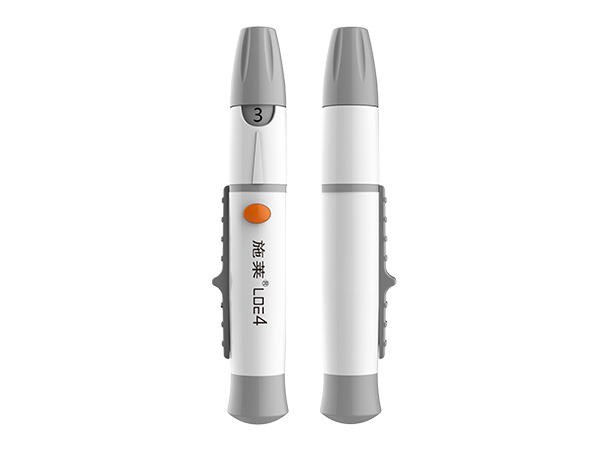
The two replacement clocks meet in the lancing devices portfolio we manufacture at SteriLance: LDE4 provides nine adjustable depth settings, supports single-hand operation, and uses a Soft-Stop-Control (SSC) system intended to stabilize the needle at launch and reduce vibration. It is intended for blood glucose monitoring at home or on the go.
Ordering information identifies LDE4 as product code 02-2201, packed one device per box and 100 devices per carton. Those quantities describe the reusable component and should not be confused with the much faster consumption rate of disposable lancets.
Designed to pair with LDE4 and most mainstream devices, Soft and SoftSure provide the disposable options in this system. Both lines are available in 33G, 30G, 28G, and 26G, packed 100 pieces per box and 5,000 per carton.
Soft is positioned for daily home glucose monitoring, while SoftSure is designed for safe, low-pain fingertip sampling and frequent checks. Those stated roles are kept within their intended context because comfort experience and sample needs vary among users.
Plan for a Routine That Can Be Repeated
Selection of lancing devices for daily use can be documented as a system: holder code, compatible lancet line, gauge, depth setting, expected tests per day, replacement rule, storage arrangement, disposal route, and source of professional guidance.
Our SteriLance system keeps adjustment and launch control in the reusable lancing device while the disposable needle is replaced for each puncture. Our support materials preserve that division so replenishment does not blur the responsibilities of the reusable device and disposable lancet
A periodic review can ask whether settings remain readable, the trigger behaves consistently, compatible stock is available, and the user can complete the routine without unplanned repeat punctures. Changes in frequency, instructions, or supply may justify renewed evaluation.
Repeated-use suitability is measured over time across a series, not from the first use alone. A workable system keeps the holder controlled, the lancet compatible and replaceable, the chosen settings understandable, and the supply-and-disposal cycle sustainable every day.
Disclaimer: This content is provided for general health education and informational purposes only. It does not constitute medical advice, diagnosis, or treatment. Individual health conditions vary, and no health education article can replace a face-to-face consultation with a qualified healthcare professional or licensed medical institution. If you have specific health concerns or feel unwell, please seek care from a licensed medical facility and do not delay treatment because of content on this platform.