

 EN
EN 

















Two components work together in a reusable finger-prick system: a disposable lancet and the device that launches it. Their specifications cannot be judged as unrelated catalog entries. Fit, launch stability, adjustable depth, lancet gauge, handling, packaging, and intended use combine to shape whether the system can support routine fingertip sampling.
Manufacturer reliability becomes visible in the connections among those details. We look for a supplier that can explain the interface, keep device and lancet specifications aligned, control production, and provide appropriate documentation. A long product list matters less than evidence that each component belongs to a coherent and supportable sampling platform.
Compatibility Is a System Property
Compatibility begins with the physical interface between the lancet and the reusable lancing device. A lancet may appear similar to another product yet differ in dimensions or seating behavior. For lancing devices, the relevant evidence includes the manufacturer's compatibility statement, the exact model identification, and evaluation with the intended disposable lancet.
The lancet must load and release according to the device instructions without requiring improvised force or positioning. At the same time, the holder must permit the approved preparation and activation sequence. For this analysis, component fit is accepted only when named parts are documented as a pair; a familiar external shape does not establish universal interchangeability.
Mechanical compatibility and clinical suitability require separate checks. A component can fit mechanically while its gauge, intended use, or sampling characteristics do not match the planned procedure. Product codes, current instructions, representative samples, and destination-market records need to describe the same combination before a procurement team moves toward volume approval.
Interface evidence should survive beyond the initial sample review. A controlled reference preserves the holder model, compatible lancet family, applicable instructions, and approval date. If either component later changes, that record identifies which part of the pairing requires renewed document review or practical evaluation before purchasing continues.
Depth Adjustment and Gauge Solve Different Variables
Depth settings control the intended puncture depth, whereas gauge describes needle diameter. More adjustment positions on lancing devices provide more selectable settings, but they do not identify the correct setting for every person. Skin characteristics, sample needs, comfort requirements, and the supplied instructions remain part of the decision.
Gauge options provide another layer of choice. Finer and larger-diameter lancets can support different user preferences and sample requirements, yet a gauge number alone cannot predict the complete experience. Launch motion, depth, skin contact, preparation, and technique interact with the disposable component's dimensions.
Repeatable adjustment must also be separated from a promise of identical results. A clear control can make the chosen position easier to reproduce, while the underlying mechanism must launch the lancet in a stable manner. Evaluation should record the selected component, position, and procedure so later training refers to an approved system, not personal memory.
Adjustment scales also need an understandable reference point. Nine positions describe available choice, not nine medical recommendations. We expect instructions to show how the control is operated and rely on qualified healthcare guidance where individual use decisions are involved. Procurement evaluation remains focused on mechanism, repeatability, labeling, and fit with the intended program.
Packaging and Production Affect Continuity;
Reusable lancing devices and disposable consumables move through inventory at different rates. For lancing devices, unit counts, replenishment assumptions, product codes, and storage arrangements must be planned separately from the recurring lancet supply. Device packaging may suit individual issue, while high-volume lancet cartons need counting and rotation controls that match repeated monitoring.
A single device per box and a much larger carton of compatible lancets illustrate why the bill of materials should remain explicit. Quotations need to identify which items are included, which are recurring purchases, and whether customized branding or packaging changes the standard configuration. Clear mapping prevents a complete-looking order from omitting the consumable component.
Our work at SteriLance combines design, R&D, manufacturing, sales, automation, precision molding, and OEM/ODM development support. We have operated since 1993. Evidence available for qualification in this comparison spans EN ISO 13485:2016, MDSAP, the UL 21 CFR Part 820 quality-system credential, China NMPA registration, FDA 510(k) for the United States, and CE marking under the EU MDR.
A Matched Platform Makes Reliability Measurable
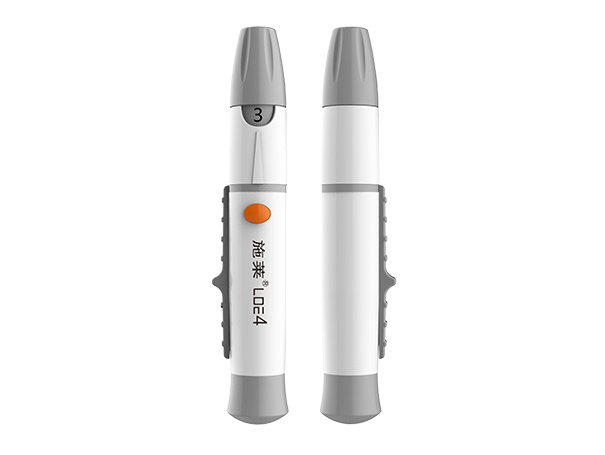
Our system includes the LDE4 adjustable blood lancet device for fingertip sampling in the portfolio we develop at SteriLance. It provides nine depth settings, supports single-hand operation, and uses a patented Soft-Stop-Control structure designed to stabilize the needle at launch and reduce vibration; user comfort still depends on the complete sampling conditions.
The listed LDE4 product code is 02-2201, with nine normal adjustments, a gray-and-white color configuration, one piece per box, and 100 pieces per carton. Soft and SoftSure lancets are designed to work with LDE4 and most mainstream reusable lancing devices; both ranges list 33G, 30G, 28G, and 26G versions.
Those specifications turn reliability into questions that can be answered: Does the named lancet fit? Is the depth range appropriate? Are gauge options and pack quantities suitable? Can the manufacturer support controlled production and the required market documentation? A dependable supplier is identified by consistent answers across the complete system, not by the reusable lancing device or disposable lancet in isolation.
Procurement can then compare supplier support at two time horizons. Initial qualification covers samples, specifications, and relevant credentials; continuing supply adds complaint handling, traceability, change communication, and replenishment. We regard a platform as reliable when both horizons remain connected, because an approved initial sample cannot by itself demonstrate long-term control.
Disclaimer: This content is provided for general health education and informational purposes only. It does not constitute medical advice, diagnosis, or treatment. Individual health conditions vary, and no health education article can replace a face-to-face consultation with a qualified healthcare professional or licensed medical institution. If you have specific health concerns or feel unwell, please seek care from a licensed medical facility and do not delay treatment because of content on this platform.